Free Implant Consultation — Limited Appointments Available This Month

Sedation Options for Implant Surgery — Choosing the Right Level of Comfort for Your Procedure

For most patients, the question isn’t whether they want sedation during implant surgery — it’s which type of sedation is right for their procedure, their anxiety level, and their medical history. We offer the full spectrum, from light nitrous oxide for routine single-implant cases to deep IV sedation for full-arch and complex surgical procedures. The goal is the same in every case: a procedure you don’t remember having and a recovery without unnecessary stress.

The four levels of sedation we offer

Different procedures call for different sedation depths. Choosing correctly is part of the treatment plan, not an afterthought.
  • Local anesthesia alone is appropriate for some patients undergoing routine single-implant placement. Modern local anesthetic agents are highly effective at eliminating pain at the surgical site, and patients who are not significantly anxious may prefer to remain fully alert during a 30–45 minute procedure. The advantage is no recovery time — you can drive yourself home immediately afterward.
  • Nitrous oxide (“laughing gas”) is the lightest level of sedation we offer. Inhaled through a small nasal mask throughout the procedure, nitrous produces a calm, slightly disconnected feeling without putting you to sleep. It wears off within 5–10 minutes after the gas is stopped, so you can drive yourself home. We use nitrous for patients with mild anxiety, longer single-implant cases, or in combination with local anesthesia.
  • Oral sedation uses prescription medication taken roughly 60 minutes before your appointment. You arrive sleepy but conscious, the local anesthesia is administered as usual, and you remain technically awake but typically remember little or nothing of the procedure afterward. Oral sedation requires someone to drive you to and from the appointment. It’s a good option for patients with moderate anxiety or those undergoing longer procedures who don’t want full IV sedation.
  • IV sedation is the deepest level we offer in-office and the standard for full-arch and complex procedures. Medication is delivered through a small IV catheter, allowing precise titration to the right depth of sedation throughout the procedure. Most patients have no memory of the surgery itself — they remember arriving, then waking up afterward. IV sedation requires a driver and 24 hours of recovery before driving or returning to work.
Four levels of dental sedation

Who administers the sedation

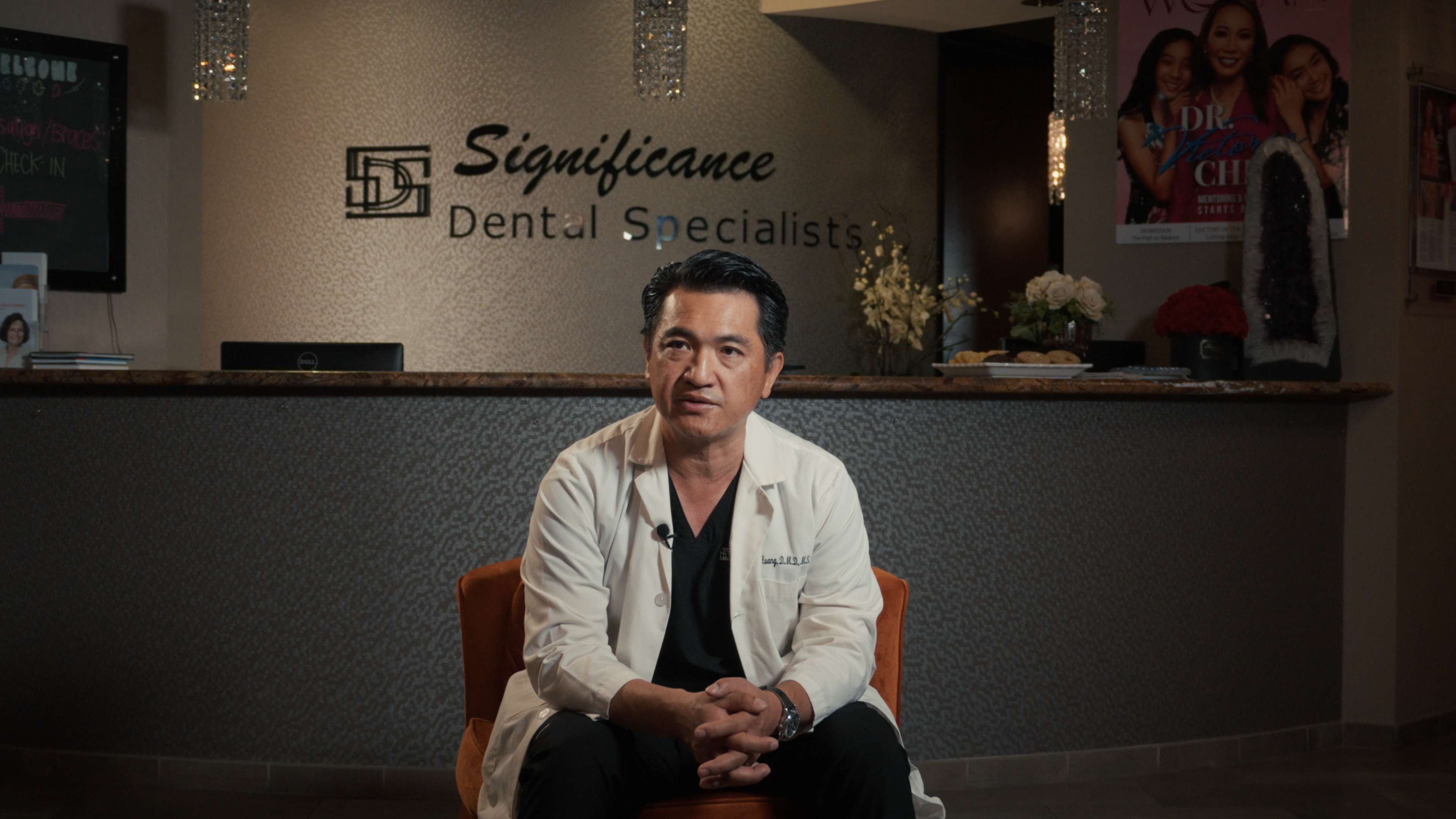
This matters more than most patients realize. In our practice, IV sedation is administered by board-certified anesthesia personnel who manage your sedation throughout the procedure while Dr. Huang performs the surgery. This separation of roles — one provider focused entirely on monitoring you, one focused entirely on the surgery — is the standard in hospital settings and provides a meaningful safety advantage over single-provider sedation.

We also maintain full hospital-grade monitoring throughout IV sedation: continuous pulse oximetry, capnography, blood pressure monitoring, and ECG. Emergency equipment and reversal agents are immediately available.
Board-certified anesthesia personnel

Which sedation level matches your procedure

The right choice depends on the procedure, the case complexity, and your personal preference. General guidelines we use in our practice:
  • Single-implant placement, no grafting: Local anesthesia or nitrous oxide, depending on patient preference. Most patients choose nitrous.
  • Single-implant placement with simple grafting: Nitrous oxide or oral sedation. Procedure time runs 60–90 minutes.
  • Multiple implants, ridge augmentation, or sinus lift: Oral sedation or IV sedation. Most patients choose IV.
  • Full-arch placement (All-on-4, All-on-X): IV sedation, always. Procedure time 2–4 hours per arch with significant surgical work.
  • Zygomatic implants: IV sedation, always. The procedure requires patient cooperation that’s not realistic without deep sedation.
  • Patients with significant dental anxiety: IV sedation regardless of procedure complexity. Patients who avoid dental care due to anxiety often have multiple problems by the time they finally seek treatment, and IV sedation lets us address the full case in fewer appointments.
Matching sedation to procedure

Pre-sedation evaluation

Before any sedation appointment, we review your medical history in detail. Conditions that affect sedation planning include sleep apnea, heart disease, lung conditions, current medications, allergies, and any history of difficulty with prior anesthesia. For most patients, sedation is straightforward. For some, additional planning or coordination with your physician is needed before proceeding.

We also discuss recent food and drink intake — IV and oral sedation both require fasting for 6–8 hours before the procedure to reduce aspiration risk.
Pre-sedation evaluation

What recovery from sedation feels like

Recovery profiles vary by sedation type:
  • Nitrous oxide: Fully recovered within 5–10 minutes. Can drive home, return to normal activities.
  • Oral sedation: Drowsy for 4–8 hours after the procedure. Cannot drive. Most patients sleep through much of the afternoon and feel normal by the next morning.
  • IV sedation: Drowsy for 4–6 hours after the procedure, with mild residual effects through the rest of the day. Cannot drive for 24 hours. Most patients sleep through the afternoon and feel essentially normal the next morning, though we recommend taking the procedure day off work.
Sedation recovery profiles

FAQs

Yes, when administered by appropriately trained personnel with full monitoring. Our IV sedation is administered by board-certified anesthesia providers with continuous patient monitoring throughout the procedure.
IV sedation in our practice is “moderate to deep sedation” — you’ll be deeply asleep, breathing on your own, and unaware of the procedure. Most patients have no memory of the surgery itself.
For most full-arch and complex procedures, IV sedation is included in the quoted treatment fee rather than billed separately. For procedures where it’s added on, the typical fee is $400–$800 depending on procedure length.
For IV and oral sedation, no food or drink for 6–8 hours before the procedure. Water in small amounts up to 2 hours before is generally fine. Specific instructions are provided when your appointment is scheduled.
Most dental plans cover sedation partially when documented as medically necessary for the procedure. Coverage varies significantly by plan. We verify your specific benefits before treatment.

Related Treatments

Send Us a Message