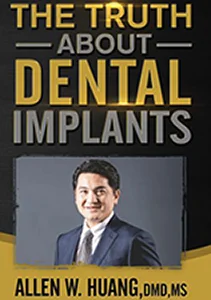
Dr. Allen Huang, DMD, MS — Board-Certified Periodontist, Diplomate of the American Board of Periodontology, and author of The Truth About Dental Implants — shares what 20+ years and 20,000+ placements have taught him about what patients deserve to know before making one of the most important health decisions of their lives.
Most information about dental implants online is written by marketers, not surgeons. This guide is different. Every insight here is drawn from Dr. Allen Huang’s published research, 20+ years of surgical practice across 8 countries, and the clinical patterns he has observed treating patients who came to him after being turned away — or misled — elsewhere.
Dr. Huang is the author of The Truth About Dental Implants and The Ultimate Guide to a Million Dollar Smile, and the Amazon bestselling co-author of Ignite Your Life with Brian Tracy. He is the only authorized 3-on-6 full-arch implant provider in Las Vegas and the city’s most decorated implant specialist — 18 consecutive years voted Top Dentist / Top Doctor.
These are not marketing claims. They are clinical observations supported by published research, board-examined expertise, and the real-world outcomes Dr. Huang has delivered for more than two decades.
“You don’t have enough bone for implants” is one of the most common things patients hear before coming to us — and one of the most frequently incorrect. Bone loss, which causes the jaw to shrink after tooth loss, was once an absolute barrier to implant placement. Today, it is manageable. Bone grafting, sinus lift, ridge augmentation, and PRF/CGF biological therapy rebuild the bone foundation that implants require. The right question is not “do I have enough bone now?” but “can we create the bone needed for a long-term result?” In the majority of cases seen at Significance Dental Specialists, the answer is yes.
Implant systems from leading manufacturers are similar in quality. What varies enormously is the surgeon placing them. A periodontist completes 2–3 additional years of post-doctoral residency specifically in surgical implant placement, bone grafting, and the management of gum conditions that determine implant longevity. Board certification — held by fewer than 3% of dentists in the United States — adds an independently verified skills standard on top of that training. For a single tooth replacement in a healthy jaw, the difference may be minimal. For complex cases — full arch, bone loss, failed implants, systemic factors — surgical expertise is the single largest predictor of a 20-year outcome versus a 5-year failure.
Traditional 2D dental X-rays show width and height but not depth. They cannot reveal the three-dimensional anatomy of bone, the location of nerve canals, or the proximity of sinus cavities — all of which are critical to safe, precise implant placement. CBCT (cone-beam computed tomography) 3D imaging changes this completely. It allows the surgeon to plan implant position, angle, and depth before the first incision is made — using digital surgical guides to execute that plan with sub-millimeter precision. At Significance Dental Specialists, CBCT imaging is standard for every full-arch case. It is not an upgrade. It is the minimum required for responsible implant surgery.
Immediate load protocols — commonly marketed as same-day implants or teeth in a day — are clinically validated. Patients can receive temporary fixed teeth on the day of surgery. What is not always communicated clearly: the temporary prosthesis placed same-day is designed to protect healing implants, not function as a final restoration. The permanent zirconia bridge is placed after osseointegration (typically 3–6 months). The same-day result is real and life-changing. It is the beginning of the process, not the end. Patients who understand this timeline are better prepared for the full experience.
The initial cost of traditional dentures is lower than implants. The lifetime cost is not. Dentures require adhesive, relining every 2–3 years as the jawbone shrinks, and full replacement every 5–8 years — because without tooth roots to stimulate it, the jawbone resorbs at a rate of approximately 25% in width during the first year alone and continues to shrink over decades. The changing bone contour means dentures that fit today will not fit in three years. Implants, by contrast, actively stimulate the jawbone, preventing resorption and preserving facial structure. When the full timeline is examined, implants are frequently the more economical choice — and always the higher quality-of-life choice.
Implants have been successfully placed in patients in their late 80s and 90s. Age alone does not determine candidacy. What determines candidacy is bone density, gum health, systemic health status, and the ability to heal following surgery — all of which are evaluated individually. The more relevant question is not “am I too old for implants?” but “is my bone and systemic health appropriate for the procedure?” A thorough evaluation — including medical history, CBCT imaging, and a direct conversation about your health goals — answers that question accurately.
Implant failure is not the end of the road. The first step is identifying why the original implant failed: was it insufficient bone volume, poor osseointegration, infection (peri-implantitis), prosthetic overload, or poor initial positioning? Each failure mode has a corresponding corrective pathway. Many patients who experienced failure elsewhere — with general dentists or non-specialist providers — have gone on to successful outcomes at Significance Dental Specialists after the underlying cause was addressed. If a prior implant failed, the goal is to understand why before recommending a path forward. That diagnosis is what makes the second attempt succeed.
All-on-4 — four implants supporting a single arch prosthesis with a pink acrylic gum-colored base — is the most marketed full-arch solution. It was a genuine advancement when introduced. But it has a visible limitation: that pink acrylic base becomes visible when you open your mouth wide, and it can look artificial in social settings. 3-on-6 addresses this with six implants and three separate segmented zirconia bridges — no pink acrylic, no artificial gum base, no one-piece prosthesis that requires removal. The patient’s own preserved natural gum line is what shows. The result is indistinguishable from natural teeth. Patients deserve to understand this distinction before choosing.
Most implant providers do not publish pricing. This creates an information asymmetry that disadvantages patients — making it difficult to compare treatment options or understand what drives cost differences. We publish our pricing transparently because patients should be able to comparison shop for implants the same way they comparison shop for any significant healthcare decision. Single-tooth implants at Significance Dental Specialists start around $4,495. Full-arch investment varies by case complexity, the number of implants required, and whether bone preparation is needed. Your treatment coordinator provides a complete, written cost breakdown before any treatment begins.
The single most protective action a patient can take is asking the right questions during the consultation. Before agreeing to any implant treatment, ask: Are you board-certified in periodontology or oral surgery? How many implants have you personally placed? Will you use CBCT 3D imaging for surgical planning? Do you use digital surgical guides? What is your 5-year success rate for cases like mine? What happens if the implant fails — and what does your warranty cover? A confident, experienced surgeon welcomes these questions. The answers reveal more than any marketing material can.
Share this summary with anyone considering dental implants. Every patient deserves to walk into a consultation informed.
Dr. Allen Huang is Las Vegas’s only Board-Certified Periodontist who is also the authorized 3-on-6 full-arch implant provider for the city. He earned his DMD from the University of Pennsylvania School of Dental Medicine and his MS in Periodontics & Implant Dentistry from the University of Illinois Chicago — where he was named the program’s first-ever Chief Resident.
His research in PRP-enhanced sinus lift bone regeneration is published and continues to inform his clinical approach for patients with severe bone deficiency. He is the CEO of Altosbiotech, an international dental implant manufacturer, and Director of the Spear Study Club Las Vegas.
Books by Dr. Huang:
The Truth About Dental Implants • The Ultimate Guide to a Million Dollar Smile • Ignite Your Life (Amazon Bestseller, co-authored with Brian Tracy)

Dr. Huang’s consultations are private, pressure-free, and built around your specific anatomy and goals — not a standard treatment menu. Come in having read this guide. Ask every question it raised. That’s exactly what it was written for.


